
Your cart is currently empty!
Belt Drive Comparison for Modern Motorcycles
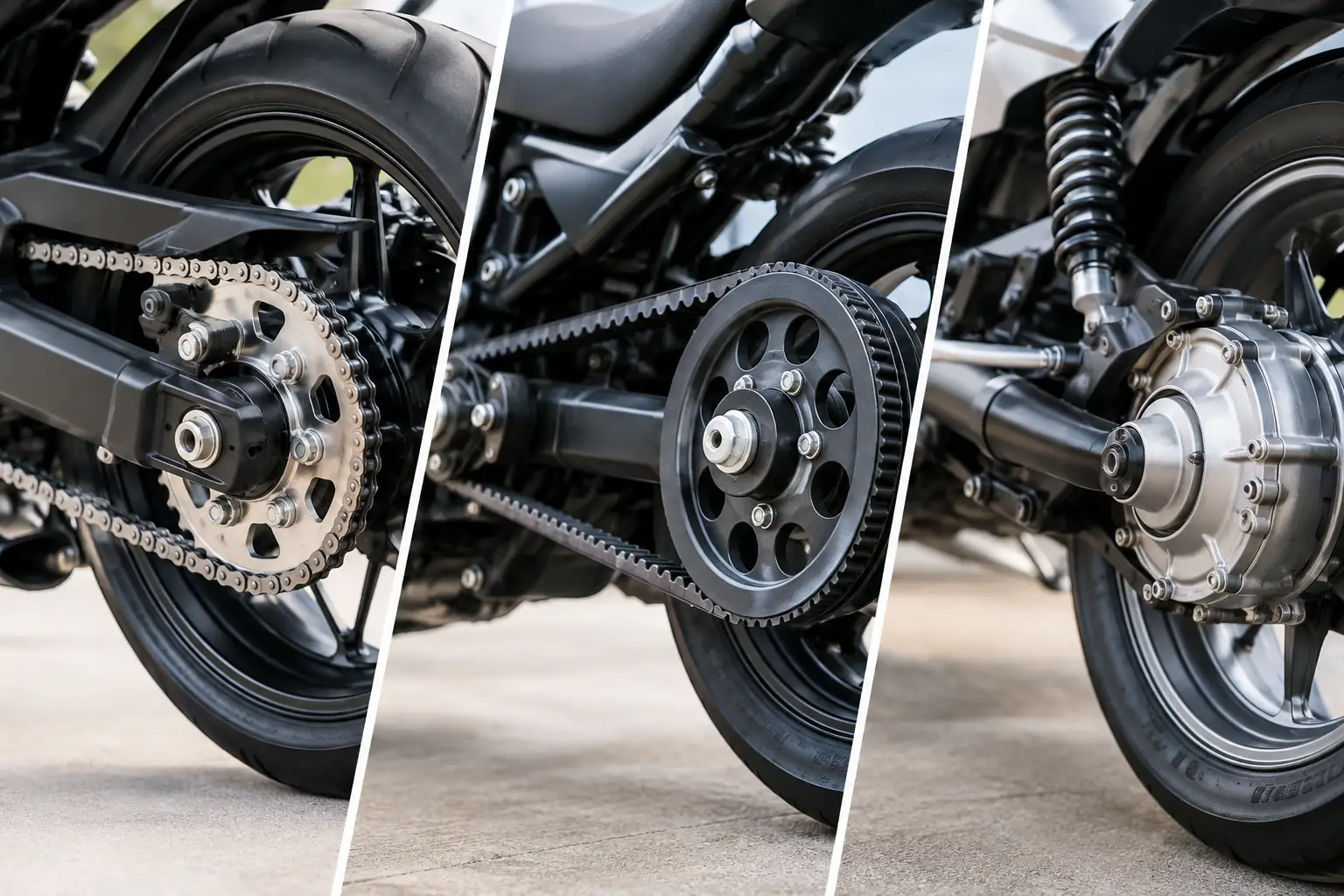
The sound of a motorcycle leaving a traffic light is part of its character. But for riders drawn to electric torque, clean design, and a quieter route through the city, mechanical noise can feel like clutter. A proper belt drive comparison looks beyond the familiar chain-versus-belt argument and asks a sharper question: what kind of ride do you want to live with every day?
A final-drive system shapes more than maintenance intervals. It affects sound, visual balance, efficiency, response, and how a motorcycle feels in the moments between home and wherever the night leads. Belt drive, chain drive, and shaft drive each carry a different philosophy. None wins everywhere.
Belt Drive Comparison: The Essential Differences
A belt drive transfers power from the motor or gearbox to the rear wheel through a reinforced toothed belt, usually made from high-strength synthetic compounds with carbon-fiber cords. Unlike a metal chain, it runs dry. Unlike a shaft, it does not require a heavy enclosed gear assembly.
That simple construction gives belts their defining appeal: quiet, low-maintenance propulsion with a clean visual profile. For an urban rider, those qualities are not minor luxuries. They change the ownership experience.
A chain uses metal links and sprockets. It is compact, strong, widely serviceable, and highly adaptable to different gear ratios. Its compromise is attention. Chains require regular cleaning, lubrication, tension checks, and eventual replacement. Ignore that routine and the chain gets louder, dirtier, and less efficient.
A shaft drive encloses its moving parts in a housing and sends power through gears. It is tidy and durable, with limited day-to-day care. The trade-off is weight, complexity, and a riding feel that can be less direct. Shaft systems are often at home on large touring motorcycles, where long-distance durability matters more than minimalist mass.
A belt sits between them. It is lighter and cleaner than a shaft, calmer and less demanding than a chain, but it comes with its own limits around packaging, damage, and peak-load use.
Why a Belt Suits the Quiet Side of Performance
For electric motorcycles, the argument for belt drive becomes especially compelling. An electric motor delivers torque immediately and without the combustion soundtrack that usually masks mechanical sounds. Every component has a voice. A dry belt keeps that voice restrained.
There is no chain rattle at low speed, no fling of lubricant onto the rear wheel or garage floor, and no metallic chatter competing with the calm of electric propulsion. The result is a more composed ride – one that lets the rider notice tire feedback, city movement, and the clean pull of instant torque.
The visual advantage matters, too. A chain has an honest industrial look, but it can make a carefully considered motorcycle appear busy. A belt creates a cleaner rear profile, especially on a machine built around classic lines and an electric heart. It does not demand attention. That is precisely why it works.
For a commuter, reduced maintenance is equally persuasive. A belt does not need routine lubrication, so wet roads and dusty parking lots do not automatically become weekend workshop tasks. It still needs inspection for tension, alignment, debris, cracking, and tooth wear. Low maintenance is not no maintenance. It is simply a more elegant ownership rhythm.
Where Chain Drive Still Has the Edge
The best belt drive comparison has to give the chain its due. Chain drive remains the performance default for serious reasons.
Chains handle high loads exceptionally well. They are relatively easy to replace, tolerate a wide range of motorcycle designs, and make gearing changes straightforward for riders tuning a machine for a particular use. Track riders, off-road riders, and builders chasing maximum power often choose chains because they are proven, compact, and flexible.
A chain is also easier to address after damage in remote conditions. If a stone, branch, or impact compromises a belt, replacement can be more involved and may require removing part of the rear assembly. A damaged chain is hardly convenient, but its components are common and familiar to most shops.
Then there is cost. Belts and their pulleys can cost more than a basic chain-and-sprocket set. For riders who are comfortable with regular maintenance and want the broadest possible service options, chain drive remains a sensible choice.
The difference comes down to intent. A chain rewards hands-on riders who enjoy mechanical involvement and need maximum adaptability. A belt rewards riders who would rather spend their free time riding than cleaning lubricant from the wheel.
Belt Drive Limits Worth Knowing
Belts are not fragile, but they ask for respect. Sharp debris can damage them. Misalignment can shorten their life. Extreme torque, aggressive launches, and harsh off-road terrain place greater demands on any final-drive system, but belts are generally less suited to those punishing conditions than quality chains.
Packaging can also influence motorcycle design. A belt has a larger diameter than a chain and cannot simply be split and rejoined in the same way. Depending on the bike, replacing it may require more disassembly. This is rarely a concern during normal ownership, but it is worth understanding before calling any system maintenance-free.
Weather is less dramatic than many riders assume. Modern belts are built to handle rain and ordinary road grime. They do not rust, and water does not wash away essential lubricant because there is none. Still, a belt should be checked after riding through deep debris, construction zones, or conditions where stones can be caught between belt and pulley.
For most paved-road riders, these are manageable boundaries, not deal-breakers. For someone routinely crossing rocky trails or chasing lap times, they are a reason to look harder at chain drive.
Efficiency, Feel, and Real-World Range
Final drive affects efficiency, although the difference is rarely the single deciding factor in a purchase. A properly adjusted belt can transmit power very efficiently, and its smooth operation supports the refined character many electric riders want. A clean, lubricated chain can also be highly efficient. Let it get dry or dirty, and friction increases.
Shaft drive typically loses more energy through its gear changes and adds rotational mass, though modern systems have improved considerably. On a large touring machine, that penalty may be acceptable. On a lighter city-focused motorcycle, every pound and every watt deserves scrutiny.
The feel is more noticeable than the spreadsheet. Chain drive feels mechanical and immediate. Belt drive feels smooth and quiet, with a controlled connection between throttle and road. Shaft drive feels substantial, sometimes with a distinct response as load changes.
That is why the right system depends on the motorcycle’s mission. A stripped-back electric street machine should feel precise, silent, and free of unnecessary fuss. A belt supports that brief naturally. It belongs to the same design language as hidden wiring, balanced proportions, and power delivered without theatrics.
RGNT Motorcycles understands that performance does not have to announce itself at every intersection. The strongest engineering choices are often the ones riders feel more than they hear.
Choosing the Drive That Matches Your Ride
Choose a belt if your riding is primarily urban or suburban, you value low upkeep, and you want a clean, quiet motorcycle that still delivers direct response. It is an especially natural fit for riders who treat their bike as part of their personal style rather than a weekend mechanical project.
Choose a chain if you prioritize hard use, tuning flexibility, easy ratio changes, or off-road capability. It asks more of you, but it gives plenty back to the rider who enjoys that relationship.
Choose a shaft when long-distance durability and minimal exposure to the elements outweigh concerns about weight and sharp response. It is a confident solution for a different kind of motorcycle.
The right final drive is not the loudest claim on a specification sheet. It is the one that disappears into the ride, leaving you with clean acceleration, a clear head, and a motorcycle that feels like it was built for your streets.