
Your cart is currently empty!
Belt Drive Versus Hub Motor for City Riding
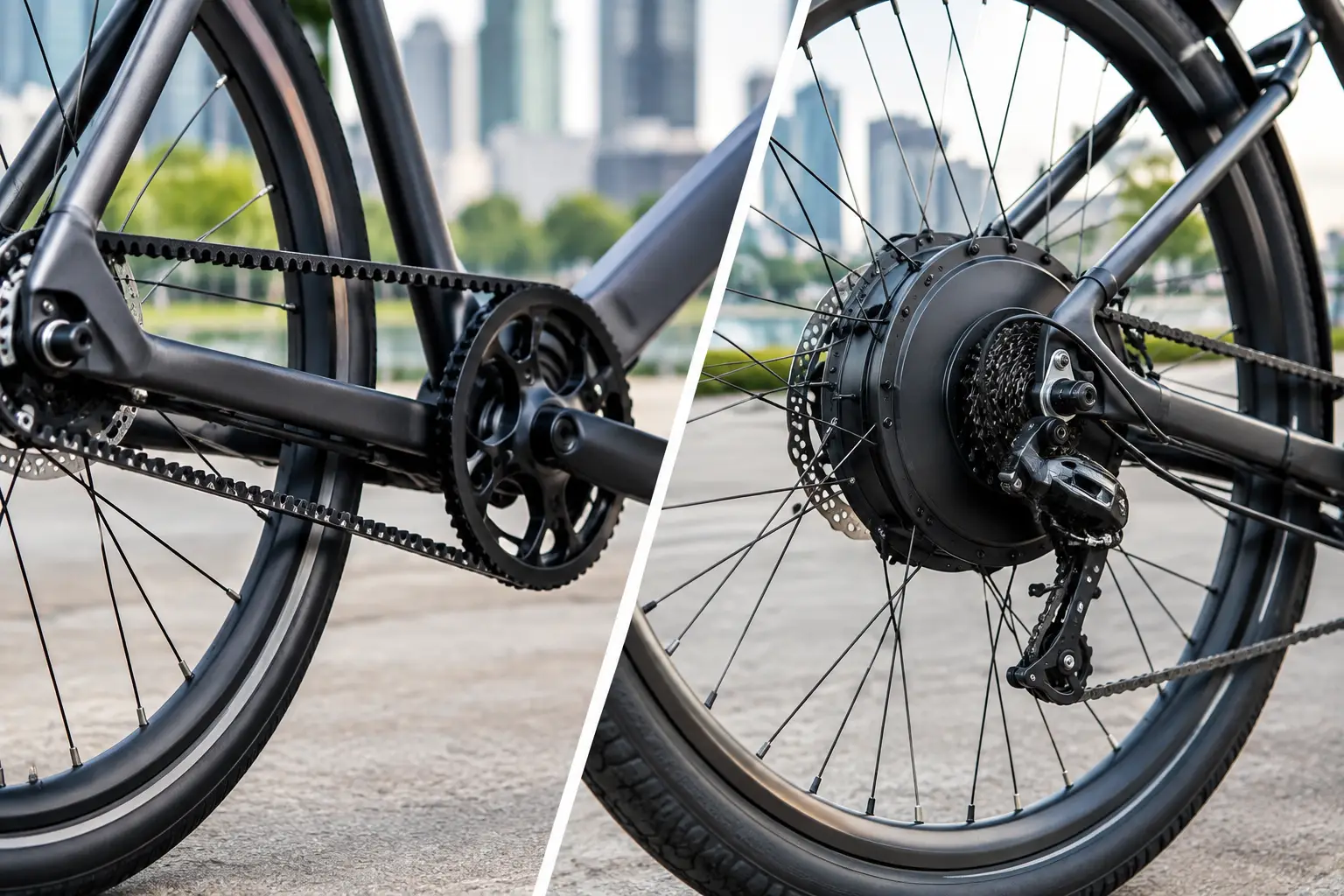
A silent electric motorcycle can feel radically different from one model to the next, even when the headline power figures look close. The reason often sits lower in the chassis: belt drive versus hub motor is not simply a question of how power reaches the rear wheel. It shapes suspension response, service needs, visual balance, and the way a bike carries itself through the city.
For riders who care about both engineering and presence, it is worth separating the terms. A belt drive is a method of transferring power. A hub motor is a motor location. They are not exact opposites, but they represent two very different approaches to electric motorcycle design.
Belt Drive Versus Hub Motor Starts With Architecture
A belt-driven electric motorcycle typically places its motor in the frame, then sends power to the rear wheel through a toothed belt and pulleys. The motor is part of the motorcycle’s central mass, protected within the chassis and away from the wheel itself. Many designs use a fixed reduction ratio, taking advantage of electric torque without the complexity of a conventional gearbox.
A hub motor sits inside the rear wheel. Its torque goes straight into the wheel, eliminating the need for a belt, chain, sprockets, and the associated alignment. It is a clean, compact idea: fewer external moving parts, fewer mechanical noises, and a remarkably direct power path.
Neither layout wins in every situation. The right choice depends on what the machine is designed to do and what the rider expects when the pavement gets rough, the traffic gets dense, or the road opens beyond city limits.
What a Belt Drive Brings to the Ride
The defining advantage of a centrally mounted motor is mass placement. Keeping motor weight low and near the middle of the motorcycle leaves the rear wheel and swingarm lighter. That matters because the wheel is unsprung mass – weight the suspension must move every time it meets a cracked road surface, expansion joint, or pothole.
Less unsprung mass generally gives the rear suspension a better chance of following imperfect pavement. The tire can maintain more consistent contact, while the chassis feels calmer rather than busy. On a well-surfaced boulevard, the difference may be subtle. On real urban streets, it can become part of the motorcycle’s character.
A belt also supports a traditional motorcycle proportion. The rear wheel can remain visually open, while the motor becomes part of the bike’s engineered center. For a design rooted in classic lines, that separation matters. It preserves the familiar silhouette of a motorcycle while replacing combustion with an electric heart.
There is a maintenance trade-off. Belt drives are far cleaner and quieter than chains, and they do not require routine lubrication. But belts do wear over time. Correct tension, pulley alignment, and inspection for damage are still part of responsible ownership. Replacing a belt is not a daily concern, but it is a service item.
What a Hub Motor Changes
The hub motor’s appeal is elegant simplicity. With no final-drive belt, there is less hardware between the motor and the road. Fewer components can mean fewer adjustment points, less drivetrain upkeep, and a very clean visual presentation.
Hub motors also deliver the immediate, unfiltered response electric riders expect. Roll on the throttle at a stoplight and the rear wheel receives torque with no clutch, shifting, or drive belt to manage. The sensation is quiet, swift, and almost improbably calm.
The compromise is weight at the wheel. A hub motor adds substantial mass directly to the rear assembly, which can make it harder for the suspension to respond to sharp bumps. This is not an automatic deal-breaker. A well-tuned motorcycle can still feel composed, especially in lower-speed urban use. But for riders who prioritize refined handling over broken pavement, a central motor can offer more room for the chassis to breathe.
Packaging is another consideration. A hub motor occupies the center of the wheel, influencing wheel design, tire service, and the visual language of the rear end. Some riders appreciate the technical statement. Others prefer the lighter, more traditional look of an exposed rear wheel and a discreetly integrated motor.
Handling Is More Than a Spec Sheet
Motorcycle handling is a conversation between weight distribution, suspension tuning, tire choice, frame geometry, and rider input. The belt drive versus hub motor decision affects only one part of that conversation, but it affects a meaningful one.
A central motor can help designers concentrate mass near the motorcycle’s center. This often benefits turn-in feel and keeps the suspension from carrying extra weight at the wheel. It is an approach that suits riders who want a machine to feel planted in fast corners yet polished across uneven streets.
A hub motor can make the rest of the motorcycle mechanically simpler, but it asks more from the suspension setup. The result can be highly effective for short, smooth commutes and relaxed city riding. It may feel less composed when speeds rise or pavement becomes unpredictable.
Do not confuse motor position with acceleration alone. Torque at the tire depends on motor output, controller calibration, reduction ratio, battery capability, traction, and the motorcycle’s overall weight. A belt-driven bike can be startlingly quick, while a hub-motor bike can be tuned for smooth, approachable response. The layout does not dictate the personality. The calibration does.
Range, Efficiency, and Regenerative Braking
A direct hub motor removes a mechanical stage from the drivetrain, which can reduce transmission losses. In theory, that is an efficiency advantage. In practice, real-world range is influenced much more by battery capacity, riding speed, wind, rider weight, tire pressure, temperature, and how often full torque is used.
A belt drive introduces another component, but modern belts are efficient when correctly tensioned. The practical range difference between two motorcycles is rarely explained by the belt alone. Look at the complete powertrain instead of treating one component as a verdict.
Regenerative braking is also not exclusive to hub motors. Both systems can recover energy when decelerating because regeneration is primarily a function of the motor controller and battery system. The sensation, strength, and usefulness of regen depend on the tuning. In city traffic, thoughtful calibration matters more than the motor’s address.
Ownership Looks Different With Each System
For riders who value low-fuss ownership, a hub motor has a persuasive argument. There is no belt to inspect or replace, and the drive system is enclosed within the wheel. That can be ideal for a rider whose priority is simple transportation with minimum mechanical attention.
A belt-driven motorcycle asks for occasional inspection, but it offers its own ownership advantages. The motor is separate from the wheel, which can make certain wheel and tire tasks more conventional. A centered motor can also be easier to access for some service work, depending on the motorcycle’s design.
Durability is not a simple hub-motor-versus-belt-drive contest. A belt can last a long time with proper setup and sensible care. A hub motor eliminates belt wear but places a critical electrical component in the wheel assembly, where it must cope with road shock, heat, water, and tire-service realities. Quality engineering and thoughtful sealing count more than marketing shorthand.
Choose the Character You Want to Ride
Choose a hub motor if the appeal is directness, mechanical minimalism, and an exceptionally clean drivetrain. It is a strong fit for riders whose routes are short, predictable, and centered on urban streets where simplicity leads the brief.
Choose a belt-driven, centrally mounted motor if ride quality, balanced handling, and a classic motorcycle stance sit higher on the list. It suits the rider who sees the daily commute as more than a transfer between addresses – someone who notices the line through a corner, the feel of the rear tire over weathered asphalt, and the quiet confidence of a carefully resolved machine.
At RGNT, that balance of classic form and electric performance is part of the point. Technology should sharpen the experience, not dominate the view.
The best setup is the one that makes you look for the longer route home. Test the suspension on the streets you actually ride, pay attention to throttle response at low speed, and choose the machine whose engineering feels as considered as its design.