
Your cart is currently empty!
Belt Drive vs Chain Motorcycle Explained
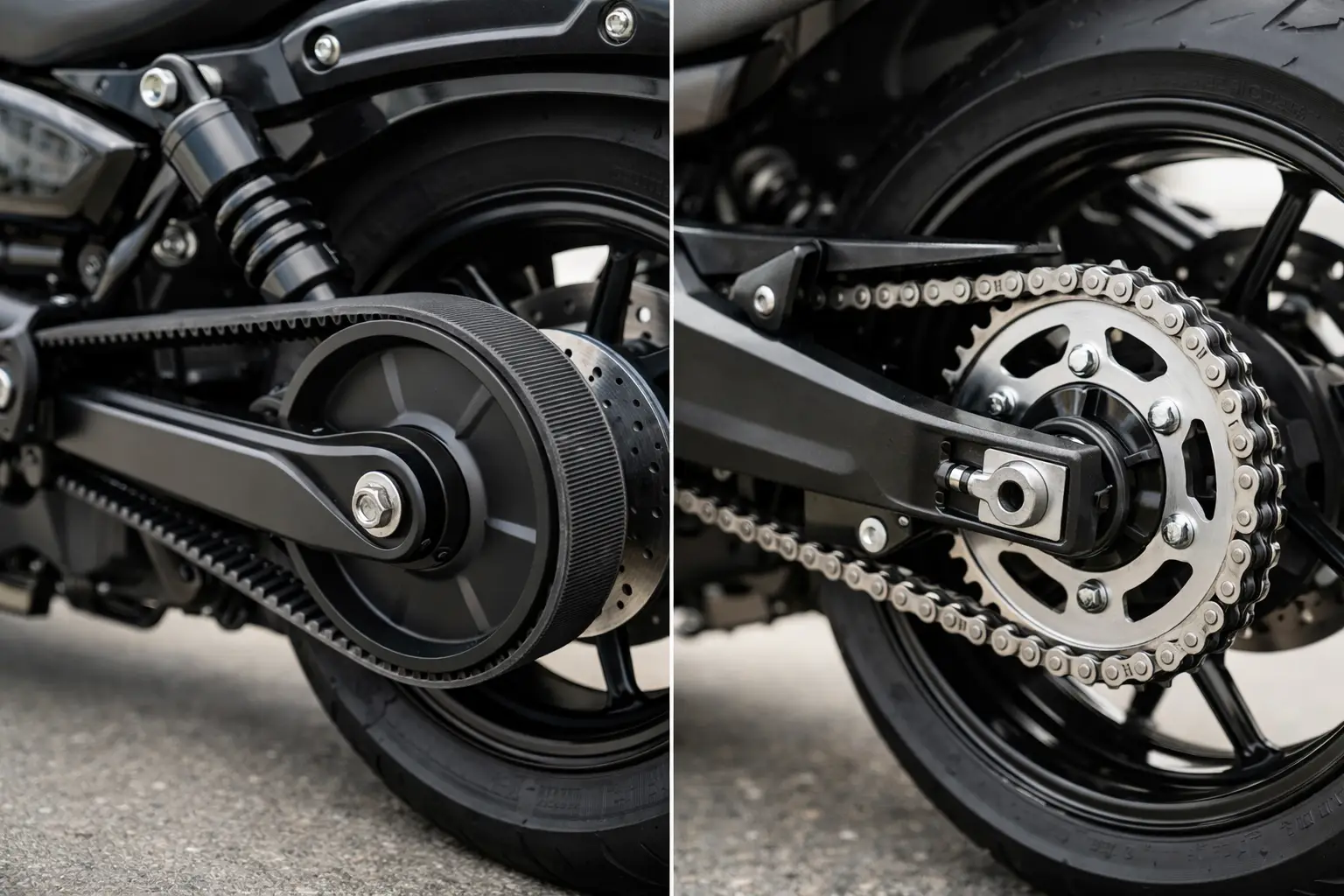
A clean rear wheel, a quiet departure, less time spent with a chain brush in hand. The belt drive vs chain motorcycle decision is not just a mechanical detail – it shapes how a bike feels to own. For riders who use a motorcycle as part of daily city life, the right final drive can be as meaningful as torque figures or charging time.
Chains remain the default across much of motorcycling for good reason. They are compact, strong, affordable, and easy to gear for performance. Belts offer a different kind of appeal: controlled silence, low maintenance, and a more considered visual finish. Neither is automatically better. The real question is what kind of riding you want to make room for.
Belt Drive vs Chain Motorcycle: The Core Difference
Both systems transfer power from the motor or gearbox to the rear wheel. A chain uses metal links running over toothed sprockets. A belt uses a reinforced rubber composite band, usually with internal teeth, running between pulleys.
The difference sounds simple, but it affects maintenance, noise, gearing flexibility, and the way the machine presents itself. A chain is exposed mechanical theater. It is purposeful, adjustable, and familiar. A belt is cleaner and more discreet. It does its work with less visual and acoustic drama.
For an electric motorcycle, that contrast becomes especially noticeable. Electric powertrains remove engine vibration, exhaust note, clutch action, and gear changes from the foreground. What remains is the immediate pull of torque and the subtle sound of the road. A belt complements that quieter character naturally, while a chain brings a more traditional, mechanical edge.
Why Chains Still Own Performance Riding
A chain is the established choice for sport bikes, off-road machines, track-focused motorcycles, and many high-output street bikes. Its biggest advantage is strength relative to size. A well-maintained chain can handle serious power and aggressive riding without requiring the larger pulley diameters a belt system often needs.
Chains also make gearing changes straightforward. Riders can swap front or rear sprockets to favor harder acceleration or more relaxed highway cruising. That freedom matters to racers, tuners, and anyone who views a motorcycle as an evolving project rather than a finished object.
They are also widely serviceable. Nearly every workshop understands chains, replacement parts are easy to source, and roadside repairs are more realistic with a chain than with a damaged belt. For long-distance riders crossing remote areas, that familiarity can be reassuring.
There is a trade-off. Chains need regular attention. They collect road grit, require cleaning and lubrication, and need their tension checked. Neglect them and the result is noise, accelerated wear, reduced efficiency, and a rear wheel that never quite looks as sharp as it should. In wet, urban conditions, that maintenance can feel less like ritual and more like another task waiting at the end of the week.
The Case for Belt Drive
A belt drive is designed for riders who prefer more riding and less workshop time. It does not need lubrication, so there is no chain lube flinging onto the wheel, tire, or garage floor. Periodic inspection and correct tension still matter, but the ownership routine is substantially lighter.
Belt systems are also quieter than chains. On a gasoline motorcycle, that difference can hide beneath the exhaust. On an electric bike, silence is part of the experience. A belt helps preserve that composed, near-silent glide through early streets and evening traffic.
Then there is the aesthetic. A belt has a deliberate simplicity that suits modern-classic design. Without greasy links and exposed lubricant, the rear of the motorcycle feels cleaner and more architectural. For a rider who cares how a machine looks parked outside a studio, restaurant, or apartment, that is not superficial. Design is part of the ownership experience.
Belts can also offer a long service life under the right conditions. They are resistant to surface rust and do not require the constant care expected of chains. For a commuter who rides predictably on paved roads, a belt can be an exceptionally sensible choice.
Where Belt Drives Ask for Compromise
Low maintenance does not mean no vulnerability. A belt can be damaged by stones, debris, or objects caught between the belt and pulley. Unlike a chain, it cannot simply be repaired with a master link at the side of the road. If the belt fails, it generally needs replacement.
Belt drives also work best within specific packaging and performance limits. Because pulleys are typically larger than sprockets, designers need to account for space around the rear wheel and swingarm. They can be less suited to severe off-road use, where mud, rocks, and constant impacts are part of the terrain.
Gearing changes are possible but less casual and less common than changing chain sprockets. Riders who constantly tune a bike for drag runs, track days, or different race circuits will appreciate the chain’s flexibility. The belt rider is more likely to value a carefully engineered setup that simply works, mile after mile.
Cost can be nuanced, too. A replacement belt and pulley system may carry a higher parts cost than a basic chain and sprocket kit. Yet when you factor in chain cleaner, lubricant, labor, and time over years of ownership, the balance can shift. The better value depends on how much you ride, where you ride, and whether you enjoy hands-on maintenance.
City Riding Changes the Equation
Urban riders place different demands on a motorcycle than weekend canyon riders or backcountry explorers. Stop-and-go traffic, variable weather, tight parking, and limited garage space make convenience matter. So does arriving without a streak of lubricant on your trousers or a maintenance job looming after a rainy commute.
This is where a belt often makes a strong argument. It supports a quieter, cleaner, more relaxed ownership experience. Pair that with the instant torque of an electric motor and the result is direct, controlled movement through the city. No excess. No unnecessary noise.
A chain can still be the right call for city use if you want maximum mechanical simplicity, plan to customize gearing, or ride a high-performance bike that demands it. But riders moving between work, social plans, and open roads may find that a belt better fits the rhythm of real life.
Electric Motorcycles and Final Drive Design
Electric motorcycles do not all use the same final-drive layout. Some use chains, some belts, and some employ direct-drive or hub-motor arrangements. The choice reflects engineering priorities as much as brand character.
Electric motors deliver torque immediately, which places meaningful load on the drivetrain from the first twist of the throttle. A chain handles high loads efficiently and remains popular for performance-oriented electric motorcycles. A belt, however, can deliver power with a refined smoothness that suits urban and lifestyle-led machines.
Because electric motorcycles are already quieter and simpler to maintain than internal-combustion bikes, a belt drive can reinforce their advantage. Fewer routine chores. Less mess. More attention left for the ride itself. That philosophy aligns naturally with a modern-classic electric motorcycle built for streets rather than spectacle.
At RGNT Motorcycles, classic lines and an electric heart are not competing ideas. They belong together. The final-drive choice should support the same feeling: immediate performance delivered with restraint, craftsmanship visible in every detail, and a ride that stands apart without needing to shout.
How to Choose Between a Belt and Chain
Start with your riding, not the spec sheet. If you ride off-road, travel far from service support, tune your motorcycle frequently, or chase maximum performance, a chain is likely the more practical system. Its durability, compact size, and easy gearing changes are hard to dismiss.
If your riding is mostly urban, suburban, or relaxed highway travel, a belt deserves serious consideration. It is quiet, clean, and low-maintenance. It makes sense for riders who value a motorcycle as a daily companion and a design object, not just a machine to modify between rides.
Also consider your relationship with maintenance. Some riders genuinely enjoy cleaning a chain, checking alignment, and dialing in tension. It creates a connection with the machine. Others would rather use that hour for a sunset ride. Both approaches are valid. The better drivetrain is the one that matches your habits instead of asking you to become someone else.
Choose the system that keeps you reaching for your helmet. A motorcycle should feel like an invitation, whether that means a perfectly adjusted chain before a fast weekend run or a silent belt drive carrying you cleanly into the city before the streets wake up.