
Your cart is currently empty!
Electric Motorcycle Instant Torque Explained
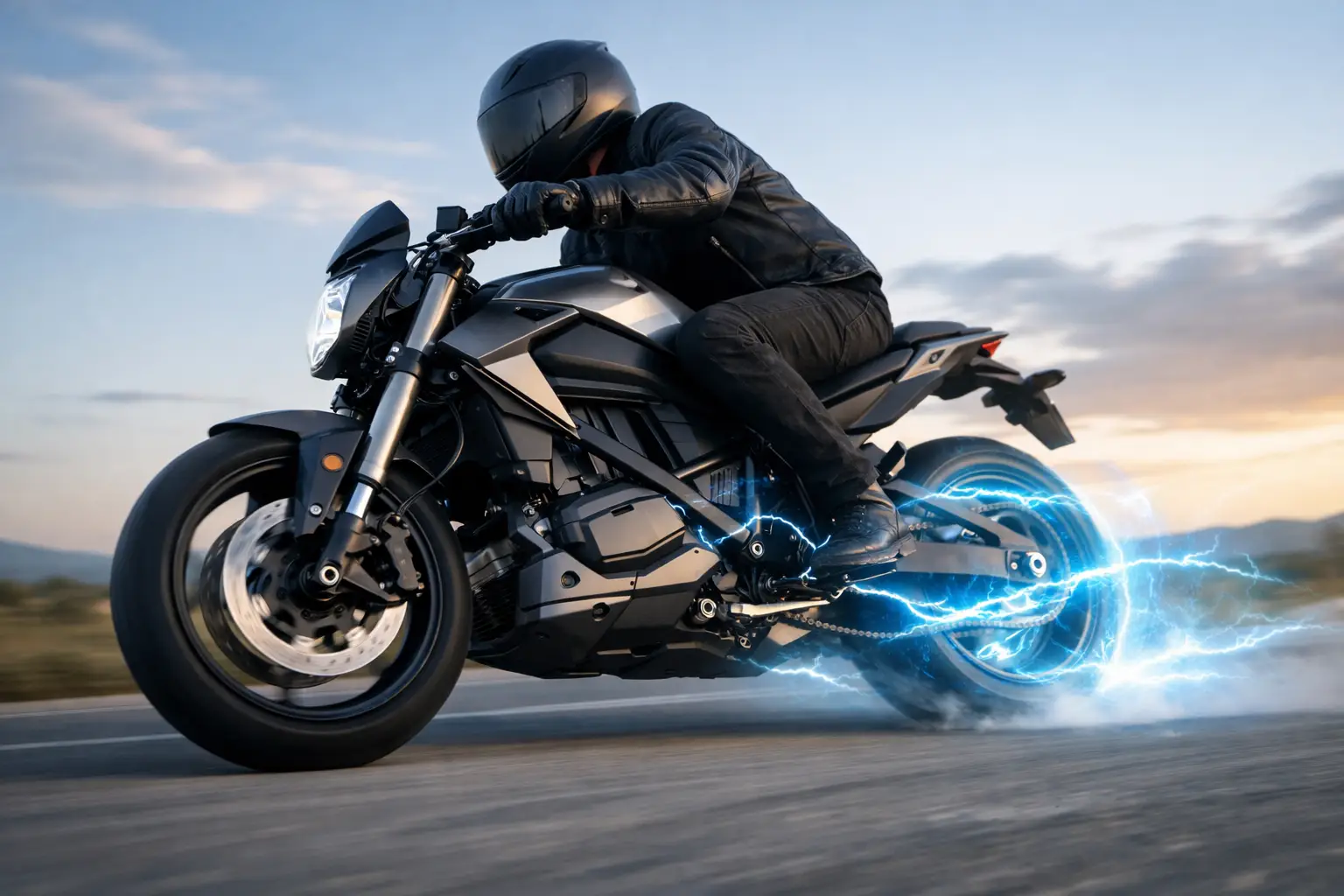
The light changes. A gap opens between traffic. With an electric motorcycle, there is no clutch work, no rising revs, no pause while the engine finds its stride. Electric motorcycle instant torque explained in one moment: twist the throttle and the bike moves with clean, immediate intent.
That sensation is one of electric riding’s defining pleasures. It makes a city commute feel less like managing machinery and more like reading the road. But instant torque is not magic, and it is not simply about being fast. It is the result of how an electric motor delivers force, how the controller meters it, and how the chassis turns that force into motion.
Electric Motorcycle Instant Torque Explained: The Core Physics
Torque is rotational force. On a motorcycle, it is the twisting force that ultimately reaches the rear wheel and pushes the bike forward. More wheel torque generally means a stronger pull at low speed, especially when moving away from a stop or accelerating out of a slower corner.
A gasoline engine needs to spin within a certain rpm range before it makes its strongest torque. That is why an internal-combustion motorcycle has gears, a clutch, and a familiar rhythm: build revs, release the clutch, shift, repeat. The rider can enjoy that mechanical ceremony, but it also means the engine is not always at its most responsive point.
An electric motor develops substantial torque from zero rpm. The rotor reacts as soon as current flows through the motor. There is no idle speed to maintain and no combustion cycle waiting to happen. The controller reads the throttle input, draws available energy from the battery, and commands the motor to produce force almost immediately.
The key word is almost. Electronics operate extremely quickly, but they still shape delivery for safety, traction, battery protection, and ride quality. A well-calibrated electric motorcycle should feel immediate without feeling abrupt. The best response has precision, not theatrics.
Why It Feels So Different on the Street
Instant torque changes the part of riding that happens most often: the first few seconds. Pulling into traffic, clearing an intersection, passing a slow-moving car, or leaving a tight urban corner all happen at low to moderate speeds. This is where an electric drivetrain feels especially alive.
On a conventional bike, acceleration can be tied to the selected gear. Too high a gear and the response softens. Too low and the engine may be busy, loud, and ready for another shift. An electric motorcycle delivers a more direct relationship between your right hand and the road. There is less mechanical negotiation between the decision to accelerate and the acceleration itself.
Silence sharpens the experience. Without exhaust note and vibration competing for attention, the rider notices the physical details: tire contact, wind pressure, the pull through the bars, the changing surface beneath the wheels. The motorcycle does not become less emotional. It becomes emotional in a different register – quieter, cleaner, and more focused.
For urban riders, that character has real value. Strong response can create a more confident margin when traffic behavior is unpredictable. It also makes ordinary routes more engaging without requiring high speeds or aggressive riding. A short green light can feel like a private launch sequence.
Torque Is Not the Same as Power
Torque gets the headlines, but power still matters. Torque is the turning force; power describes how quickly the motorcycle can do work. In practical terms, torque is a major part of the immediate shove you feel, while power becomes increasingly relevant as speed rises.
This distinction explains why a bike can feel startlingly quick from a stop yet have a more modest top speed than a larger gas motorcycle. Electric motors are exceptionally effective in the low-speed range where commuters spend much of their time. As speed increases, the system’s voltage, motor design, gearing, and software limits have a larger influence on acceleration.
That is not a weakness. It is a design choice. A lightweight, city-focused electric motorcycle does not need to chase superbike figures to feel compelling. It needs usable response, composed handling, and power that arrives exactly when the rider asks for it. For A1-class riding, accessible performance can be far more meaningful than numbers built for a racetrack.
The Controller Is the Difference Between Sharp and Crude
The motor produces torque, but the controller gives it manners. Think of it as the conductor between throttle, battery, motor, and rear tire. It determines how force builds, how much current is delivered, and how the bike responds when grip is limited.
A poorly tuned system can make instant torque feel like an on-off switch. That may sound dramatic in a spec sheet conversation, but it is tiring in traffic and unsettling on wet pavement. A refined system lets the rider make small, accurate adjustments. Roll on gently through a crowded block, then ask for decisive acceleration when the road opens.
Ride modes can alter this character further. A restrained mode may soften initial response and preserve range. A more direct setting can make the throttle feel sharper and more immediate. Neither is automatically better. The right choice depends on rain, road surface, passenger load, experience, and mood.
Regenerative braking also plays a role in the overall feel. When the rider closes the throttle, the motor can act as a generator, converting some motion back into battery energy. Strong regeneration may provide an engine-braking sensation, while lighter regeneration allows more coasting. The most natural setup is the one that gives the rider a predictable connection to the road.
The Rear Tire Still Has the Final Say
Instant torque does not cancel physics. Every motorcycle is limited by the grip available where the rear tire meets the pavement. Cold tires, painted lane markings, gravel, wet leaves, and uneven asphalt can all reduce the amount of force the road can accept.
That is why smooth throttle technique matters as much on an electric motorcycle as it does on any other bike. Immediate response rewards a relaxed wrist and deliberate inputs. The goal is not to snap the throttle open at every light. The goal is to place the motorcycle exactly where you want it, with the right amount of acceleration for the moment.
Weight transfer matters too. As the bike accelerates, load shifts rearward, increasing rear-wheel grip up to a point. On a compact, agile motorcycle, this can make launches feel planted and confident. But if the surface is poor or the rider demands too much too quickly, traction control and thoughtful throttle calibration become valuable allies.
This is also why the best electric motorcycles feel designed rather than merely electrified. Battery placement, frame balance, suspension setup, tire choice, and software tuning all influence whether torque feels elegant at the wheel.
Does Instant Torque Affect Range?
It can. Hard acceleration requires high current, and repeated full-throttle launches use more energy than smooth, progressive riding. Fast riding also increases aerodynamic drag dramatically, so sustained speed is often a larger range factor than the occasional quick start.
The advantage is that electric torque does not require the rider to keep an engine spinning at high rpm just to stay responsive. In city riding, where slowing and accelerating are constant, the drivetrain can feel both eager and efficient. Regeneration may recover a portion of energy during deceleration, though it will never fully erase the energy used to accelerate.
Range is therefore not a single fixed number. Temperature, speed, elevation, tire pressure, rider weight, passenger load, and throttle habits all shape the result. The more honestly a rider understands those variables, the more satisfying electric ownership becomes.
A New Kind of Motorcycle Character
Some riders miss the vibration, shifting, and soundtrack of combustion. That preference is real, and no electric motorcycle needs to apologize for offering a different experience. Electric torque replaces part of the old ritual with another kind of connection: quiet movement, direct response, and the freedom to hear the city as you pass through it.
RGNT Motorcycles approaches that contrast with classic lines and an electric heart. The visual language remains familiar and purposeful, while the drivetrain changes the conversation at the throttle. It is not nostalgia frozen in time. It is heritage with a sharper response.
The real appeal of instant torque is not that it makes every ride a drag race. It gives the rider authority in the moments that matter most. Start smoothly, accelerate decisively, leave the noise behind, and let the road make the next request.