
Your cart is currently empty!
Guide to Electric Motorcycle Charging Options
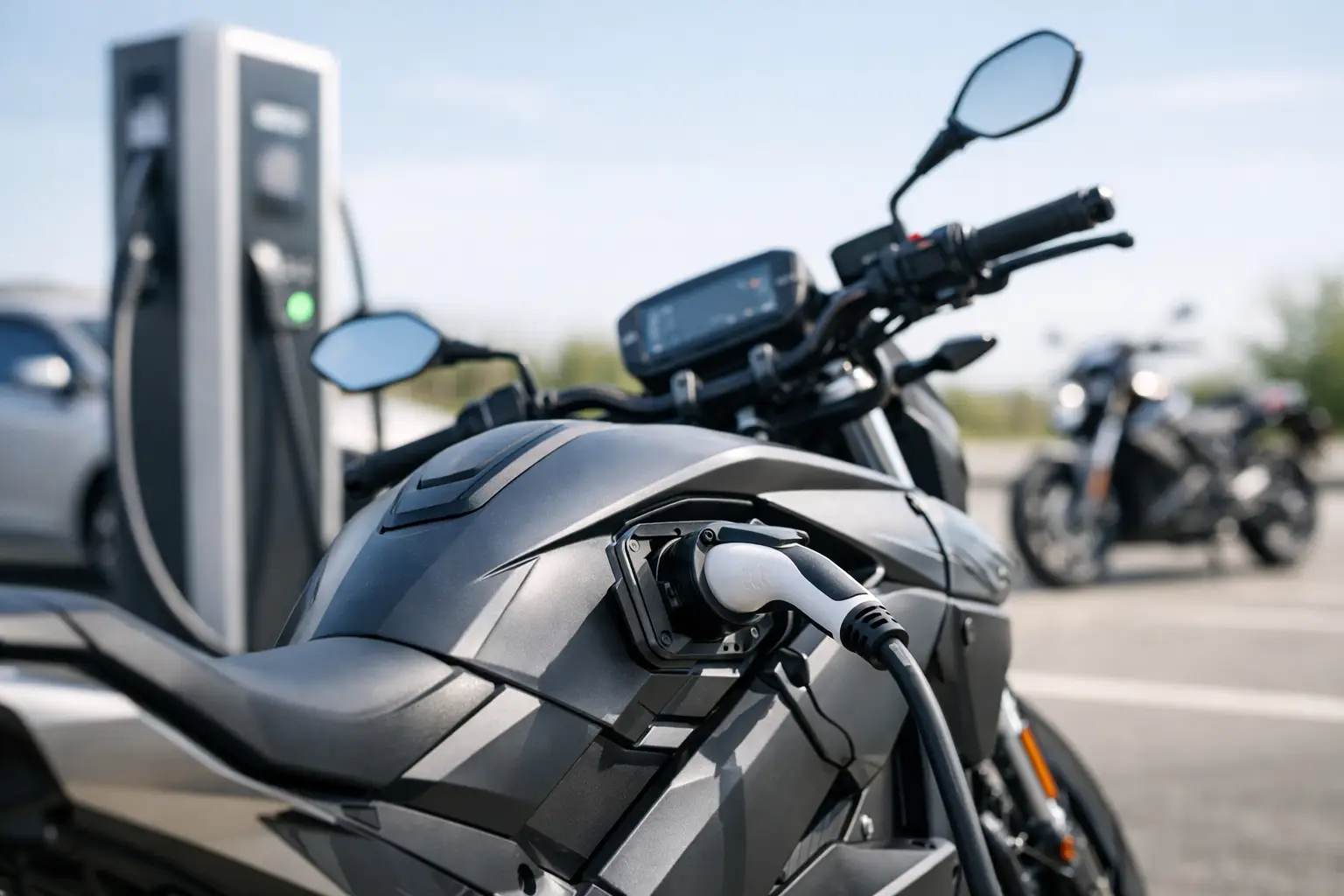
The best electric rides do not begin at a gas station. They begin quietly, where you park. This guide to electric motorcycle charging options is about making that quiet convenience work for your actual life – the commute across town, the last-minute dinner plan, the longer Saturday escape beyond the city.
Electric charging is often discussed as a technical hurdle. In daily riding, it is usually the opposite. Once your routine is set, plugging in becomes as unremarkable as charging your phone overnight. The key is knowing which charging option fits your bike, your building, and the way you prefer to move.
Start with the charger your motorcycle accepts
Before choosing a charging setup, check the motorcycle’s battery capacity, onboard charger rating, connector type, and stated charging times. These details determine what the bike can actually draw from a power source. A public charger may offer more power than your motorcycle can accept, while a simple wall outlet may already be enough for a full overnight recharge.
This distinction matters because charging equipment is not automatically faster just because it looks more serious. The rate is limited by the lowest-capacity part of the system: the outlet or station, cable, onboard charger, or battery-management system.
For many urban electric motorcycles, the practical question is not, “What is the fastest charger available?” It is, “Can I arrive home, plug in, and leave with a full battery tomorrow?” If the answer is yes, home charging will carry most of your riding life.
Home charging: the standard that makes electric easy
Home is where electric ownership earns its reputation. Instead of scheduling fuel stops, you restore range while the motorcycle is parked anyway. For riders with a private garage, driveway, or assigned space with power, this is the cleanest arrangement.
A standard wall outlet
Level 1 charging uses a standard household outlet. It is the simplest entry point and often requires no added equipment beyond the charging cable supplied or specified for the motorcycle. Charging is slower, but slow is not a problem when the bike sits for eight to twelve hours.
A wall outlet makes particular sense for short daily mileage. If your commute and errands use only part of the battery, overnight charging can comfortably replace what you used without any change to your routine. It also keeps installation costs low.
There are limits. Older outlets, damaged wiring, extension cords, and shared circuits are not details to ignore. Charging draws power continuously for long periods, so the outlet and circuit should be in sound condition. If there is uncertainty, have a qualified electrician assess the setup. Premium ownership should not rely on improvised wiring.
A dedicated 240-volt circuit
A 240-volt circuit, commonly called Level 2 charging, is the better choice when you want shorter recharge times, ride more frequently, or share access with another EV. Depending on the motorcycle and charger, it can significantly reduce the time needed to recharge.
This is less about chasing numbers and more about freedom. A faster home setup gives you room for an evening ride after work, a recharge over dinner, then another departure later that night. It is especially useful for riders who cover higher daily mileage or dislike planning around a long charging window.
Installation is a property decision as much as a vehicle decision. Homeowners may need a panel-capacity review, permits, and weather-rated equipment for outdoor parking. Renters and condo owners may need approval from a landlord, homeowners association, or building manager. Start that conversation early and frame it clearly: dedicated charging adds everyday convenience and can make a parking space more valuable.
Public charging: useful, not necessarily essential
Public charging changes what is possible, particularly for riders without home access. It can also add confidence on days that run longer than planned. But it should be treated as part of a charging plan, not always the plan itself.
Public stations vary widely. Some are in garages, retail lots, workplaces, hotels, and municipal parking areas. Availability, pricing, access hours, connector support, parking rules, and station reliability can differ from one location to the next. Check these details before you need them, not when the battery is low and the weather has turned.
Know the connector before you arrive
The station connector must match your motorcycle, or work with an approved adapter where one is permitted by the motorcycle manufacturer. Do not assume that a connector designed around cars will fit or be appropriate for every electric motorcycle.
Also remember that a high-powered DC fast-charging station is not automatically usable. Many electric motorcycles are designed for AC charging and do not support DC fast charging. That is not a flaw. It reflects different battery sizes, packaging constraints, and real-world riding patterns. A lighter, more elegant motorcycle built for the city does not need to imitate a large electric car to be useful.
Make public charging part of the destination
The most refined public-charging habit is not waiting beside your motorcycle. It is charging while you are already doing something worthwhile. Park at work. Plug in during a gym session. Add range while you have coffee, meet friends, or spend an afternoon in a neighborhood worth arriving in.
If charging carries a parking fee or idle fee, set a reminder to return before the session ends. Public infrastructure works best when riders treat it as shared space. Move on when the motorcycle has what it needs.
Workplace charging can be the sleeper advantage
For apartment dwellers, workplace charging can be more valuable than a public network. A motorcycle parked for most of the workday has time on its side. Even a modest charging rate can recover a meaningful amount of range between morning and evening.
If your employer does not offer charging, it can be worth asking. Motorcycle charging often requires less space and energy than car charging, and it supports a practical commuter benefit. Come prepared with the motorcycle’s charging requirements and a simple proposal for safe installation. The request lands better when it is specific.
Charging away from home: plan for the ride you want
Longer rides require a different mindset, but not a more anxious one. Start with your expected range in the conditions you will actually face. Speed, temperature, elevation, passenger weight, cargo, tire pressure, and aggressive acceleration all affect consumption. Electric torque is immediate and addictive. Use it with intention when range matters.
Map charging stops around places you would choose to stop anyway. A route with a reliable station near food, a scenic town, or a proper break is better than one that depends on a single obscure charger with no backup. Leave a range buffer instead of riding the battery down to a dramatic final percentage.
Four habits make longer rides less complicated:
- Check station access, connector compatibility, and recent availability before departure.
- Identify a backup charger within reach of your planned route.
- Arrive with enough reserve to handle a closed lot, occupied space, or detour.
- Charge more often during natural stops rather than waiting for a deep battery drain.
That final point is easy to overlook. Lithium-ion batteries are generally happier with regular, moderate charging than repeated extremes. Your motorcycle’s manual remains the authority on daily charge limits, storage guidance, and battery care for its specific battery system.
The charging option that fits your life
There is no single best setup. A rider with secure garage parking and a short commute may need nothing beyond a properly inspected outlet. A high-mileage commuter may appreciate a dedicated Level 2 circuit. A city resident without private parking may build a dependable rhythm around workplace and neighborhood stations.
The right choice also depends on ownership horizon. If you are staying in a home for years, a professionally installed circuit can be a strong investment in ease. If you rent, a portable, approved charging solution and a reliable local charging map may be the smarter move. Do not buy infrastructure for an imaginary lifestyle. Build around the rides you take now, with enough headroom for the rides you want next.
A quieter ritual, not another errand
Electric motorcycles reward small rituals. Park. Connect. Let the battery recover while the city carries on. There is no fuel smell on your gloves, no queue beneath fluorescent lights, no unnecessary noise at the end of the day.
For riders drawn to classic lines and an electric heart, that is part of the point. Charging should fade into the background so the ride can stay in the foreground. Set up the option that feels natural, protect a little range for the unexpected, and leave room in your plans for the road that looks better than the direct route.