
Your cart is currently empty!
Motorcycle Charger Selection Without Guesswork
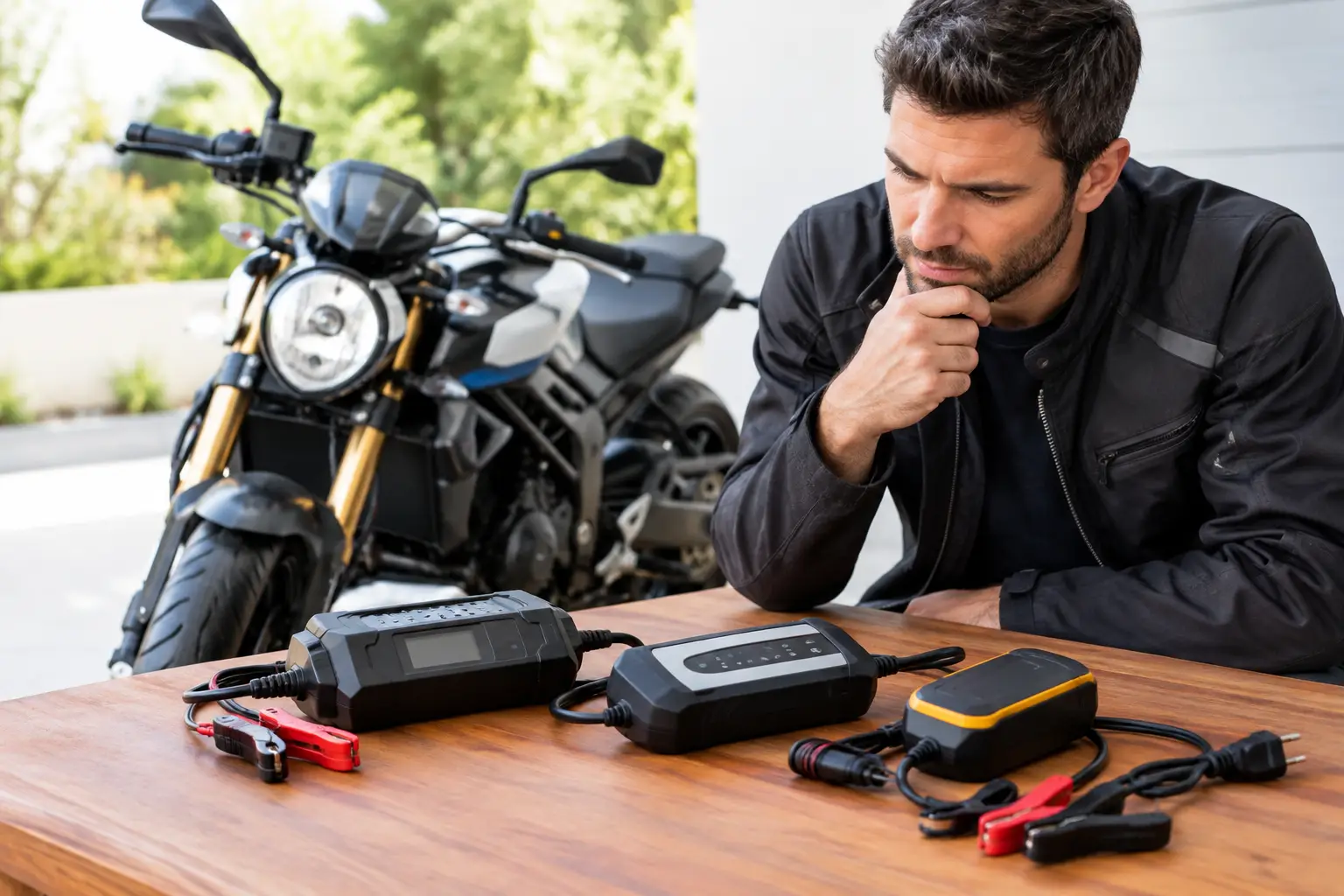
A silent ride begins long before the throttle turns. It begins in the place where your motorcycle rests: a city garage, a clean corner of the workshop, or a private parking space beneath your apartment. The right charging setup keeps an electric motorcycle ready without becoming another piece of daily friction.
Motorcycle charger selection is not about buying the biggest unit or chasing the highest number on the box. It is about matching your bike, your battery, your electrical supply, and the way you actually ride. Get those four things right and charging becomes almost invisible. Plug in, step away, return ready.
Motorcycle Charger Selection Starts With Your Bike
The first rule is simple: use charging equipment approved for your motorcycle’s battery system. Voltage, connector design, communication protocols, and maximum current are not interchangeable details. They determine whether the battery charges correctly, how quickly it charges, and whether its protection systems can do their job.
Electric motorcycles commonly use lithium-ion battery packs, managed by a battery management system, often called a BMS. This system monitors cell voltage, temperature, current, and charge state. A compatible charger works with those limits. An incompatible or poorly made charger can create nuisance faults at best and battery damage at worst.
Before comparing chargers, confirm three specifications in your owner’s documentation: the required input voltage, the charging connector, and the motorcycle’s maximum accepted charging power. The final figure matters more than the charger’s advertised output. If your bike can only accept a certain rate, a more powerful unit will not make it charge faster.
This is where restraint pays. The best setup is not the most aggressive one. It is the one engineered to suit the machine.
Understand the Difference Between the Charger and the Cable
People often use the word charger for everything between the wall outlet and the motorcycle. That can be misleading. Some motorcycles carry the charging hardware onboard, while the device connected to the wall functions mainly as a safe power supply and communication point. Others use an external charger that converts AC power into the DC power the battery needs.
That distinction affects what you need to buy. A replacement cable is not automatically a replacement charger. A public charging adapter is not automatically suitable for home use. If there is any uncertainty, check the motorcycle manufacturer’s guidance before connecting new equipment.
Choose Charging Speed Around Real Life
Charging speed should match your routine, not your impatience. For many urban riders, standard overnight charging is exactly right. Ride to work, take the long route home, plug in after dinner, and wake to a full battery. Quiet ownership has its own kind of performance.
A 120-volt household outlet, often referred to as Level 1 charging, can be enough for riders with modest daily mileage and consistent overnight access. It is the simplest route, but it is also the slowest. If you arrive home with a deeply depleted battery and need to ride again in a few hours, it may feel restrictive.
A dedicated 240-volt circuit, commonly described as Level 2 charging, can provide a more capable home setup when the motorcycle supports it. This is a strong choice for frequent riders, shared motorcycles, or anyone who wants more flexibility between rides. The motorcycle still sets the ceiling. A high-capacity Level 2 unit does not override the bike’s onboard charging limit.
Think in terms of recovery time. If your normal day uses 30 percent of the battery, you only need a setup that reliably returns that energy before the next ride. If you often use 80 percent, ride multiple times in a day, or have unpredictable schedules, faster compatible charging earns its place.
Do Not Confuse Faster With Better
High charging power can be useful, but it comes with trade-offs. It may require electrical work, a dedicated circuit, a more expensive unit, and more attention to installation. Depending on the motorcycle and battery design, routine high-rate charging can also generate more heat than slower charging.
For a design-led electric motorcycle, the goal is not to turn the garage into a pit lane. It is to create a dependable rhythm that preserves the freedom of spontaneous riding. Fast charging is valuable when it solves a real problem. Overnight charging is excellent when it does not.
Confirm the Connector Before You Buy
Connector compatibility deserves more than a quick glance at product photos. Motorcycle charging connections vary by market, model, and charging architecture. A plug may look familiar yet be electrically or mechanically wrong for your bike.
Start with the port on the motorcycle, then identify the connector on the charger or charging station. Confirm whether you need a fixed cable, a detachable cable, or a manufacturer-approved adapter. Also check cable length. A charger that reaches in a showroom may not reach in a real garage, especially when the outlet is behind the bike or beside a parking pillar.
Avoid relying on improvised adapters unless they are specifically approved for the motorcycle and charging equipment involved. An adapter must do more than physically connect two shapes. It must preserve safe electrical operation and, where required, the communication between the bike and the supply equipment.
In the United States, public and home charging infrastructure can vary widely. A rider who charges only at home may value simplicity. A rider who uses workplace or destination charging should consider what stations are common on their routes before committing to a connector strategy.
Build a Home Setup That Feels Effortless
A premium motorcycle deserves more than a loose cable crossing a damp garage floor. Home charging should feel composed: protected from impact, easy to reach, and simple to use in low light.
Choose a location where the cable can reach the motorcycle without stretching, pinching, or becoming a trip hazard. Keep the charging equipment away from standing water, direct spray, and places where a car door or moving bicycle can strike it. If the unit is installed outdoors, verify its weather rating for the conditions it will face year-round.
For a permanent 240-volt installation, use a qualified electrician. The circuit should be correctly rated for the equipment and local electrical code. A dedicated circuit is often the cleanest option, particularly when charging will be frequent. It reduces the chance of overload from tools, appliances, or other garage equipment sharing the same line.
Skip lightweight extension cords for regular charging. They can introduce voltage drop, heat, and unnecessary risk, especially over long runs. If a temporary solution is unavoidable, follow the motorcycle and charger instructions exactly and treat it as temporary.
Small Details Make Charging Better
Good charging habits are deliberately unglamorous. Inspect the cable occasionally for cuts, crushed sections, damaged pins, or discoloration around the plug. Keep connector caps clean and dry. Do not force a connector that will not seat smoothly.
It also helps to think about security. In a shared parking area, a lockable charger, cable management, or a protected outlet enclosure can prevent tampering and keep the setup looking intentional. The best electric motorcycle experience is calm, not cluttered.
Consider Battery Care Alongside Convenience
Most modern battery systems are built to manage daily charging intelligently, but every battery ages with time, heat, and use. Follow the motorcycle manufacturer’s recommendations for long-term storage and routine charging. If the bike will sit for weeks, the ideal charge level may differ from the level you use for daily riding.
Temperature changes the equation. Charging a battery immediately after a hard ride in extreme heat, or when the battery is very cold, may cause the system to reduce charging power or delay charging. That is protection, not failure. Give the machine the conditions it needs to look after itself.
If your charger offers scheduling, it can be useful for aligning charging with your departure time or household energy habits. But convenience features should remain secondary to compatibility and safety. A basic, approved charger on a proper circuit beats a feature-packed unit that does not suit the motorcycle.
A Better Way to Make the Decision
Start with the motorcycle’s official charging requirements. Then measure your daily mileage, where the bike parks, and how many hours it normally sits between rides. From there, choose the slowest setup that reliably fits your life, unless faster charging gives you a clear and frequent advantage.
That approach avoids overbuying while leaving room for the rides that matter. A short charge before an evening escape, a full battery before the morning commute, and the confidence to take the longer way home. Choose charging equipment with the same instinct you bring to the motorcycle itself: clean design, honest capability, and nothing unnecessary.